

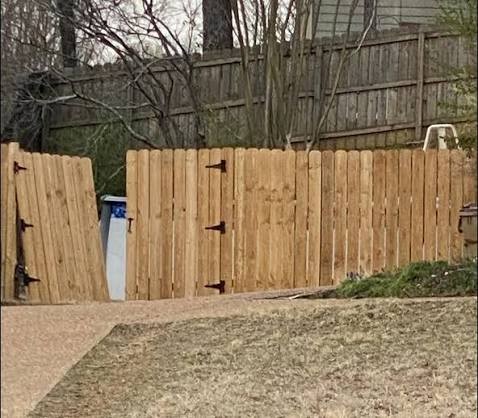
A garden gate that suddenly starts scraping along the path usually gets blamed on the gate. Sometimes that’s right. Quite often, it isn’t. Before buying new hinges or ordering a replacement, I would check the post supporting it. I’ve seen plenty of apparently faulty garden gates where the gate itself was perfectly serviceable. The real problem was a timber post moving by an amount small enough to miss by eye, but large enough to throw the whole opening out of alignment.
Gates are unforgiving things.
A fence post can lean slightly without attracting much attention. Move a gate post by the same amount and suddenly the latch misses, the bottom catches the paving and somebody has to lift the gate every time they want to close it.
That’s useful, because gates often provide an early warning that something else is happening.
Start with the gaps
Before reaching for a screwdriver, stand back.
Close the gate and look at the gaps around it.
If the gate was installed reasonably well, there should be fairly consistent clearance between the gate and its posts. It doesn’t have to look as though it was measured with laboratory equipment, particularly on an older timber gate, but the gaps tell you a great deal.
If the gap is wider at the top on one side and narrower at the bottom, something has moved.
Now work out what.
A gate itself can sag. This tends to produce a recognisable diagonal change in its shape and position. Hinges can loosen. Fixings can pull from timber. The gate can swell after prolonged wet weather.
But the posts can move too.
I normally look at the whole opening rather than concentrating immediately on whichever bit is rubbing.
That distinction matters because adjusting a gate to compensate for a moving post may temporarily make it close again without actually fixing anything.
A few millimetres can be enough
People sometimes expect a failing fence post to be visibly leaning.
It doesn’t need to be.
Imagine a reasonably tall timber post supporting a substantial gate. A small amount of movement at ground level is amplified further up the post. The latch doesn’t need to move very far before it stops meeting its receiver correctly.
The same applies to the hinge side.
If the supporting post moves, the gate moves with it.
That is particularly relevant with heavier gates. Weight creates a constant load on the post, and the further the gate projects away from its hinges, the greater the leverage being applied.
This is one reason gate posts deserve more thought than simply using whatever timber happens to match the rest of the fence.
I would rather overspecify a gate post slightly than spend the next few years adjusting a gate that was too heavy for its support from day one.
Give the post a gentle test
You don’t need specialist equipment to identify obvious movement.
Open the gate and gently push the top of the hinge post in different directions. Watch what happens at ground level.
The word “gently” matters.
You aren’t trying to prove that you can knock the fence down.
A sound post should feel secure. There may be a little natural flexibility in the structure, particularly with timber fencing, but there shouldn’t be obvious rocking where the post enters the ground.
If there is, look more closely.
With timber posts, deterioration around ground level is common. The upper section can still look surprisingly good while the timber around or immediately below the surface has begun to rot.
I’ve removed posts where the visible timber looked respectable enough, only for the section at ground level to have lost a substantial amount of its strength.
That’s the part homeowners rarely inspect.
Rotten posts don’t always look rotten
Timber doesn’t conveniently deteriorate from the top down where everybody can see it.
The area around ground level can experience repeated wetting and drying, and water can sit around poorly detailed installations. Eventually the post begins to lose strength at exactly the point where it needs it.
Sometimes you’ll see obvious signs.
The timber may feel soft. The surface can crumble when pressed. There may be visible splitting or discolouration.
Other times the first obvious symptom is the gate no longer lining up.
This is why simply rehanging the gate can be the wrong repair.
If the supporting post has started deteriorating, moving the hinges slightly might buy some time, but the underlying problem remains. As the post continues to weaken, the gate will move again.
Eventually the post can fail altogether.
It might be the footing instead
Not every moving post is rotten.
Sometimes the problem is underneath it.
A gate post needs an appropriate footing because it is doing more work than an ordinary intermediate fence post. It isn’t simply resisting wind loading from the fencing around it. It is also supporting the weight and movement of the gate.
Every time the gate opens and closes, forces are transferred through the hinges and into the post.
A shallow or inadequate footing can gradually move.
Ground conditions matter as well. Soil changes with moisture, drainage and season. Periods of very wet weather can soften ground, while prolonged dry periods can cause some soils to shrink.
Around Barnsley and elsewhere in South Yorkshire, gardens can vary enormously. You can move from relatively straightforward ground to clay, rubble and disturbed ground within a surprisingly short distance, particularly around older properties and former industrial areas.
I’ve dug enough post holes in Yorkshire to know that the neat-looking lawn on top tells you very little about what the spade is going to find underneath.
Old concrete is another favourite.
And bricks.
Lots of bricks.
Don’t automatically blame the hinges
Hinges do fail, of course.
Fixings work loose. Screws corrode. Timber around a fixing can split. Hinges themselves can bend, particularly if they were undersized for the gate.
The important thing is to diagnose rather than guess.
Open the gate slightly and lift the outer edge.
If there is obvious play at the hinges while the post remains stationary, the hinge or its fixings deserve attention.
If the whole post moves with the gate, that’s a different conversation.
Also look at the gate itself. Is it still square? Are its joints sound? Has a brace failed? Is the timber badly deteriorated?
You might have more than one problem.
An old gate with loose hinges attached to a slightly unstable post can produce exactly the sort of repair where replacing one component simply reveals the next weakness.
Weather can temporarily change a timber gate
There is another reason not to rush into replacement.
Timber moves.
After prolonged wet weather, a timber gate can absorb moisture and swell. Clearances that were adequate during dry weather can disappear. A gate that suddenly catches after weeks of rain may settle again as conditions change.
That doesn’t mean every sticking gate should simply be ignored until summer.
You need to look at the pattern.
If the gate remains square, the posts are solid and the problem is a very small reduction in clearance during wet conditions, adjustment may be enough.
If the gate has progressively dropped over months, the latch is significantly out of position or the supporting post is moving, weather alone probably isn’t the explanation.
This is where experience helps.
The symptom might be the same – a gate won’t close – but the repair can range from a minor adjustment to replacing a structural post.
Driveway gates magnify the problem
The same principles apply to larger gates, but the forces increase.
A wide gate creates considerable leverage at its supporting post. Heavy timber gates can place a substantial permanent load on hinges, fixings, posts and foundations.
With driveway gates, I would be particularly reluctant to start adjusting hardware until I knew the supporting structure was sound.
If a large gate has dropped, look at both sides of the opening.
Check the posts for vertical alignment. Look for movement around their bases. Inspect hinges and fixings. Check whether the two leaves still meet correctly if it is a pair of gates.
Also consider whether something outside the gate has changed.
Has paving moved?
Has the driveway surface lifted?
Has new surfacing reduced the clearance underneath?
Not every gate that appears to have dropped actually has.
Sometimes the surrounding fence is the clue
A gate rarely exists completely independently of the boundary around it.
Look at the neighbouring fencing.
If the gate post is leaning and the adjacent fence section has also moved, the problem may extend beyond the gate itself.
Perhaps the next post is unstable. Perhaps vegetation has been pushing against the fence. Perhaps several older timber posts are beginning to deteriorate at roughly the same age.
This is where a straightforward gate repair can turn into a wider fence repair assessment.
That doesn’t automatically mean replacing everything.
If one post has failed and the rest are genuinely sound, repair the failed section.
But if four posts of the same age are showing deterioration and one has finally given way, I’d be cautious about spending too much money treating each failure as an isolated event.
There comes a point where repeated repairs become false economy.
A replacement gate won’t straighten a bad post
This is the part worth remembering.
You can buy an excellent gate and hang it from a poor support.
It will still give you problems.
In fact, replacing a lightweight old gate with a heavier new one can make an already marginal post fail more quickly. The new gate looks fantastic for a while, but the underlying structure hasn’t improved.
I see the same mistake elsewhere in fencing. People naturally concentrate on the visible component. They choose the panel, the boards or the gate, while the posts and foundations receive far less attention.
I tend to think the opposite way around.
Make the structure right first.
A modest gate hanging from properly installed, stable posts will generally cause fewer headaches than an expensive gate hanging from something that moves every time the ground gets wet.
So if your gate has started dragging across the path, don’t assume it needs replacing.
Close it. Stand back. Look at the gaps. Check the hinges. Then put a hand on the post.
The gate might simply be the first part of the fence honest enough to tell you there’s a problem.
